 Touchline Sport
There’ll be plenty of Manchester United supporters looking at the Champions League fixture list this week, seeing Sabah FK and immediately reaching for Google.
Who are they?
Fair question.
Sabah were founded on 8 September 2017. Two days after their ninth birthday, they’ll walk out at Old Trafford in the Champions League league phase.
Nine years old and already on a European away day to Manchester. Some clubs are still deciding whether the new badge was a good idea by that stage.
They haven’t sneaked in through a fortunate draw either. Sabah started in the first qualifying round on 7 July and played eight matches just to get here. They’re the only club from that opening round to survive all four stages.
Now Manchester United, Borussia Dortmund, Barcelona, Napoli and Arsenal are waiting.
UEFA apparently decided a gentle introduction would be boring.
Sabah aren’t going to win the Champions League. I’m fairly comfortable putting that down in writing.
The more interesting question is whether they can become the team nobody particularly enjoys playing.
How Sabah Grew This Quickly
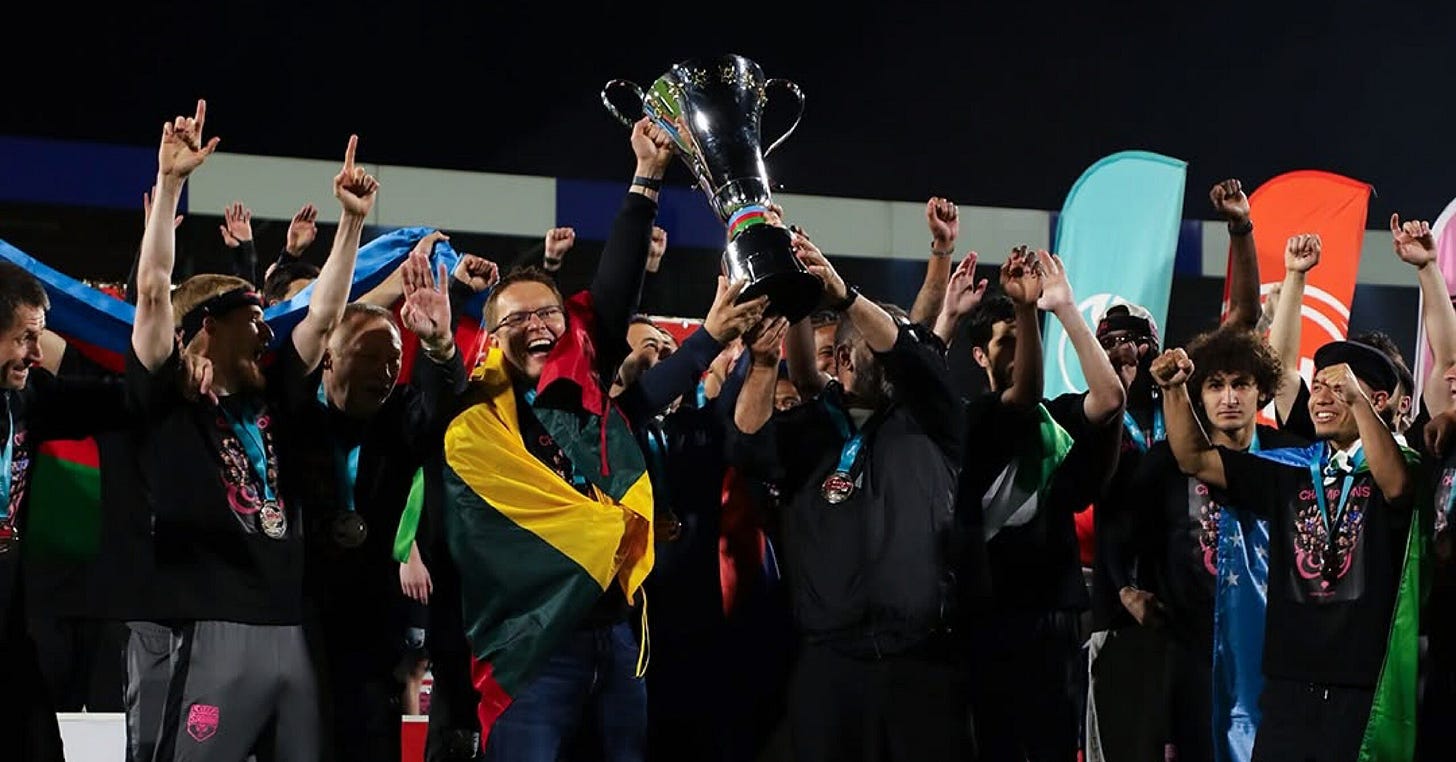
Sabah’s entire history can nearly fit into one decent football conversation, but the speed of it can make the rise look more accidental than it actually was.
They entered Azerbaijan’s First Division in 2017/18 and finished fifth. They didn’t win promotion in the normal way. After meeting the Azerbaijan Football Federations Association’s licensing requirements, they were admitted to the Premier League for the following season.
The first few years were fairly ordinary. Seventh. Sixth when the Covid-hit season stopped. Fifth again.
But while the league table was moving slowly, the club itself was becoming more serious.
Commercial backing increased. Bank Respublika became closely associated with the club, including the naming of Sabah’s home ground in Masazır. Investment went into the senior squad, but also into youth football and the wider structure around it.
Sabah’s academy started producing results of its own. Their U19s won consecutive national championships in 2023/24 and 2024/25, while reserve and younger age-group teams also collected titles.
That part is easy to miss when looking at the first team.
Sabah were not simply trying to buy their way from fifth place into Europe. They were building a club capable of operating at a higher level while the senior team was catching up.
The next step came in 2022/23.
Sabah finished second in the league and qualified for Europe for the first time. They beat RFS home and away, took a 2-0 lead against Partizan and eventually went out on penalties in Belgrade.
The following summer brought more experience. Sabah beat Maccabi Haifa 3-0 away, lost the return 6-3 after extra time and somehow still advanced on penalties after a 6-6 aggregate draw.
Then Stephen Kenny and St Patrick’s Athletic arrived and ruined the fun, beating them 1-0 in both legs.
Those European defeats were part of the growth too.
By the time Valdas Dambrauskas arrived, Sabah were no longer a new club trying to discover whether they belonged in Europe. They had already played Partizan, Maccabi Haifa and St Pat’s, built a stronger academy and become a regular near the top of the domestic league.
What they were missing was trophies.
First They Had To Catch Qarabağ
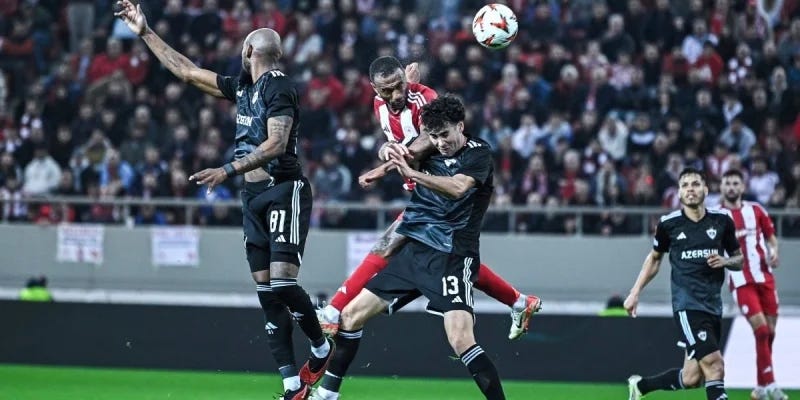
The first arrived in May 2025 when Sabah beat Qarabağ 3-2 after extra time in the Azerbaijani Cup final.
That result now looks like the point where the club moved from promising to genuinely dangerous.
Under Dambrauskas, Sabah followed it by winning the 2025/26 league with 78 points from 33 matches. They won 24, drew six and lost only three, scoring 75 goals and conceding 25.
Qarabağ finished nine points behind.
That is not a small detail.
Qarabağ had won 12 of the previous 13 Azerbaijani league titles. For years, anyone trying to build a serious club in Azerbaijan eventually ran into the same problem.
Qarabağ were already there.
Sabah finally got past them.
They then beat Zirə 2-1 in the cup final to complete the domestic double and make it three major trophies in two seasons.
For a club founded in 2017, that is ridiculous progress.
How They Reached The Champions League
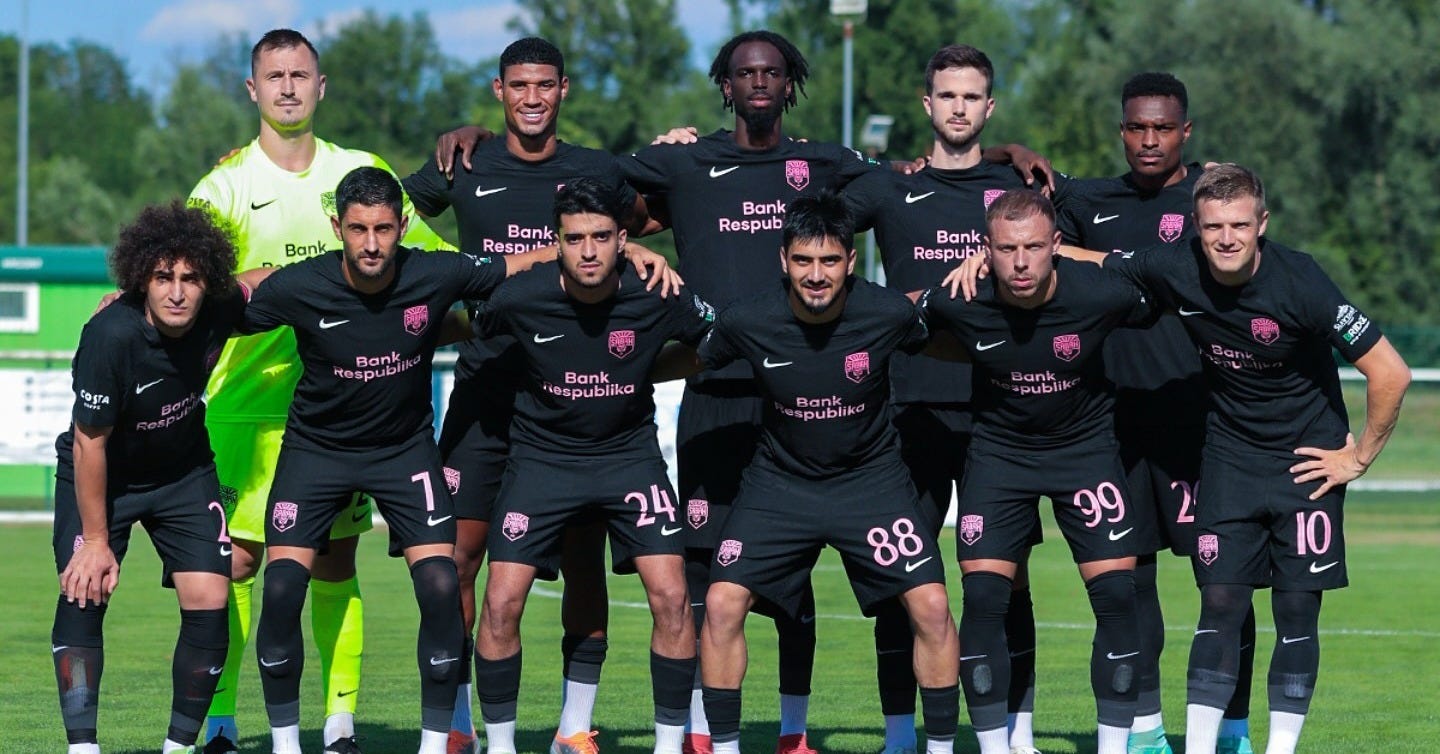
Their 2026 European run is probably the best explanation for why they might cause problems now.
The first two rounds were almost suspiciously calm.
Sabah beat The New Saints 2-0 at home and 2-1 away to progress 4-1 on aggregate. KuPS came next. A 1-0 home win was followed by a 2-0 victory in Finland.
Four matches. Four wins. Seven goals scored. One conceded.
Then things got considerably messier.
Sabah lost 2-1 away to AGF Aarhus in the third qualifying round before responding with a 4-0 win at home.
Hapoel Be’er Sheva were waiting in the play-off.
Sabah lost the first leg 2-1 again.
In the return, they fell behind twice, dragged the tie into extra time and eventually won 5-2, progressing 6-4 on aggregate.
Across all eight qualifiers, Sabah scored 18 goals, more than any other team, while conceding seven.
They did it with only 44% average possession.
That is probably the number Manchester United should care about most.
Sabah don’t need the ball to feel comfortable.
They completed 763 of 920 passes, recovered possession 87 times and took 48 corners. Veljko Simić scored six goals, Joy-Lance Mickels got four and Tymoteusz Puchacz supplied five assists.
This wasn’t eight matches of hanging on and hoping.
They can sit through periods without the ball and still attack quickly when the space appears.
And when a tie starts getting weird, Sabah seem perfectly happy to join in.
The Money Helps, But The Structure Matters More
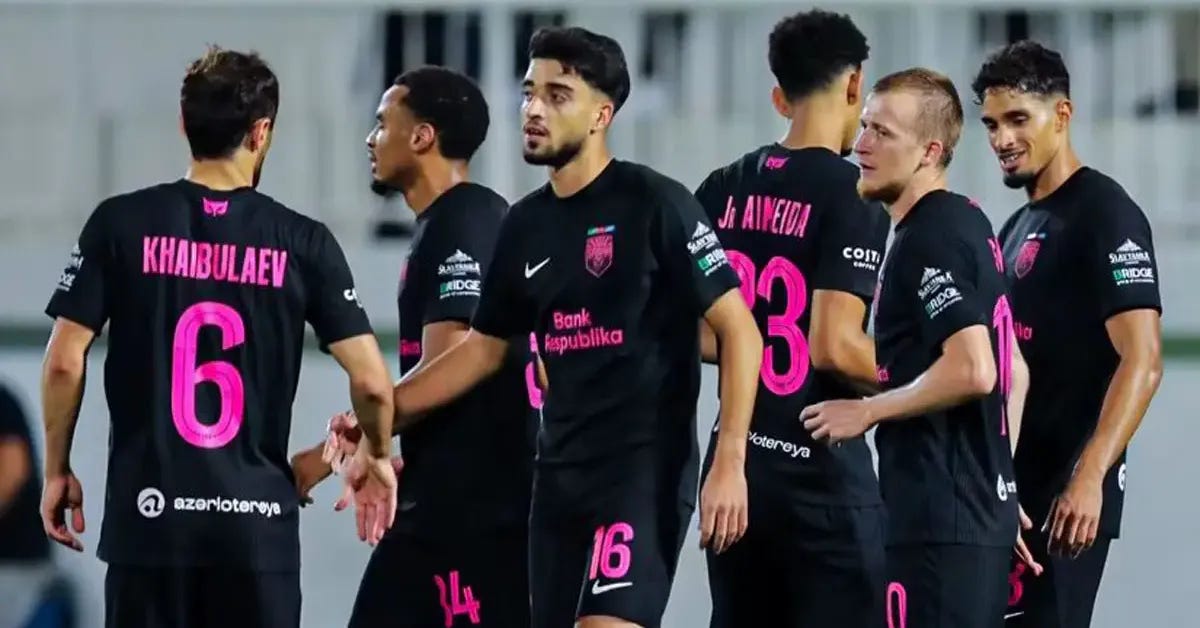
Sabah are an underdog in Champions League terms.
They’re not penniless.
Their 2025 accounts showed operating income of 26.727 million manat, roughly €13.55 million. Sponsorship and advertising supplied 19.150 million manat, about €9.71 million.
Ticket income was only 69,100 manat, around €35,000, while broadcasting brought in just 11,000 manat, roughly €5,600.
They spent 14.164 million manat, around €7.18 million, on salaries and bonuses.
So yes, there is serious backing behind this.
But the money makes more sense when placed beside the decisions around it.
Sabah have strengthened the first team, developed the academy, accumulated European experience and hired a coach whose career has largely been built around closing gaps in smaller leagues.
That is the growth story.
Not one massive spending spree.
A series of steps that made the next one possible.
And compared with what waits for them now, the spending is still tiny.
Transfermarkt estimates Sabah’s entire squad at €17.55 million.
Manchester United’s is worth more than €750 million.
Arsenal’s sits around €1.3 billion.
UEFA’s guaranteed league-phase starting payment alone is €18.62 million, meaning one Champions League qualification is worth more than Sabah’s entire estimated squad.
That money could accelerate the club again.
Somebody Richer Is Going To Have A Horrible Night
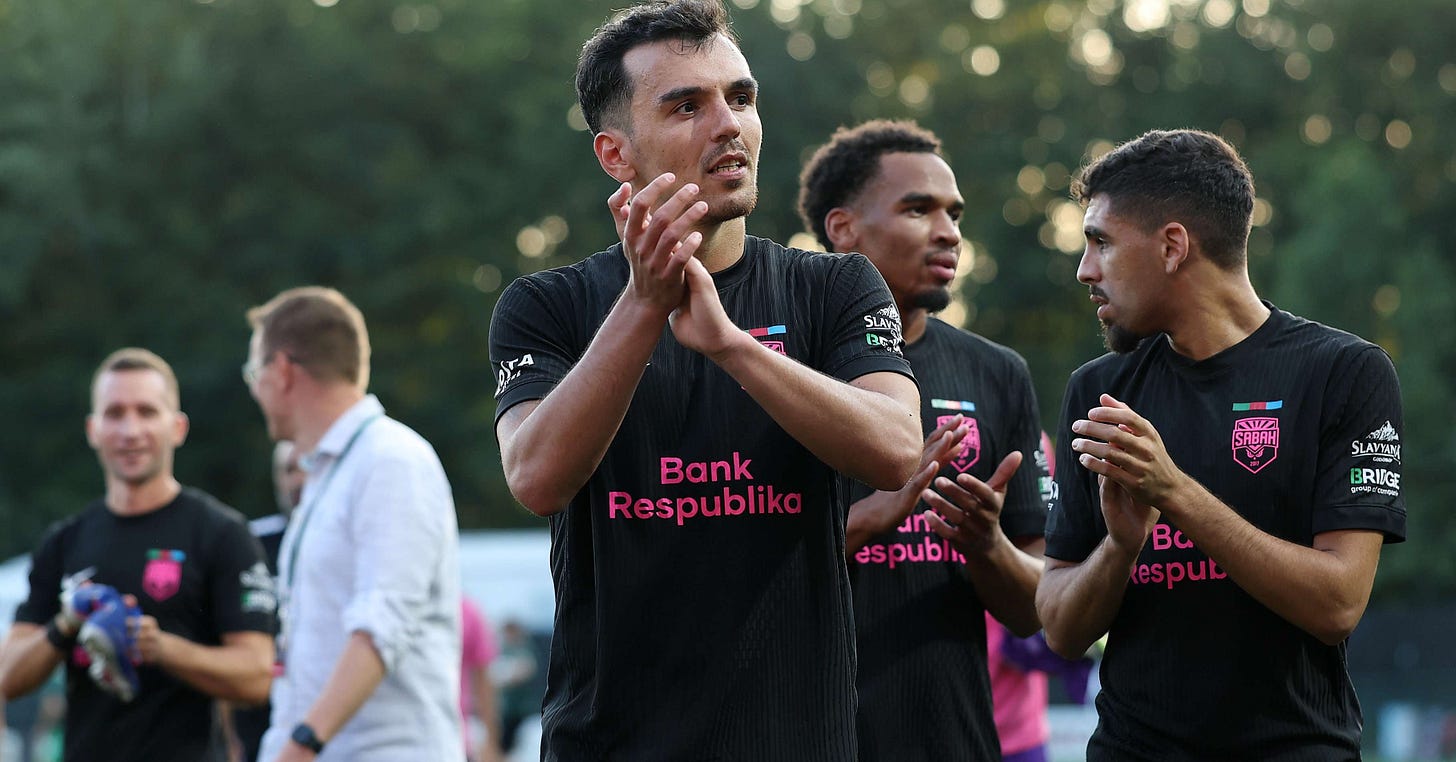
Dambrauskas has spent much of his managerial career in leagues where you cannot solve every problem by asking the owner for another €50 million midfielder.
Sabah look like a team shaped by that.
They can score. They’re comfortable without possession. They’ve learnt from European defeats. They’ve caught the club that dominated their own league. They’ve already won ties after losing first legs and recovered from falling behind inside matches.
They might get a hiding somewhere too.
Barcelona and Arsenal are perfectly capable of reminding Sabah exactly how wide the gap still is.
But Sabah do not need to reach the knockout rounds to become one of the stories of this Champions League.
They need one big night.
Maybe two.
Somebody with a squad worth several hundred million euro is eventually going to find themselves ten minutes from full-time, a goal down, watching Simić head towards the corner flag while 25 lads from Azerbaijan behave as though this was always the plan.
And all those Manchester United supporters Googling Sabah before kick-off?
They might not need to search the name again.
If this one landed, the newsletter’s where the rest of it lives — two or three pieces a week, no noise.
Subscribe for free