 Touchline Sport
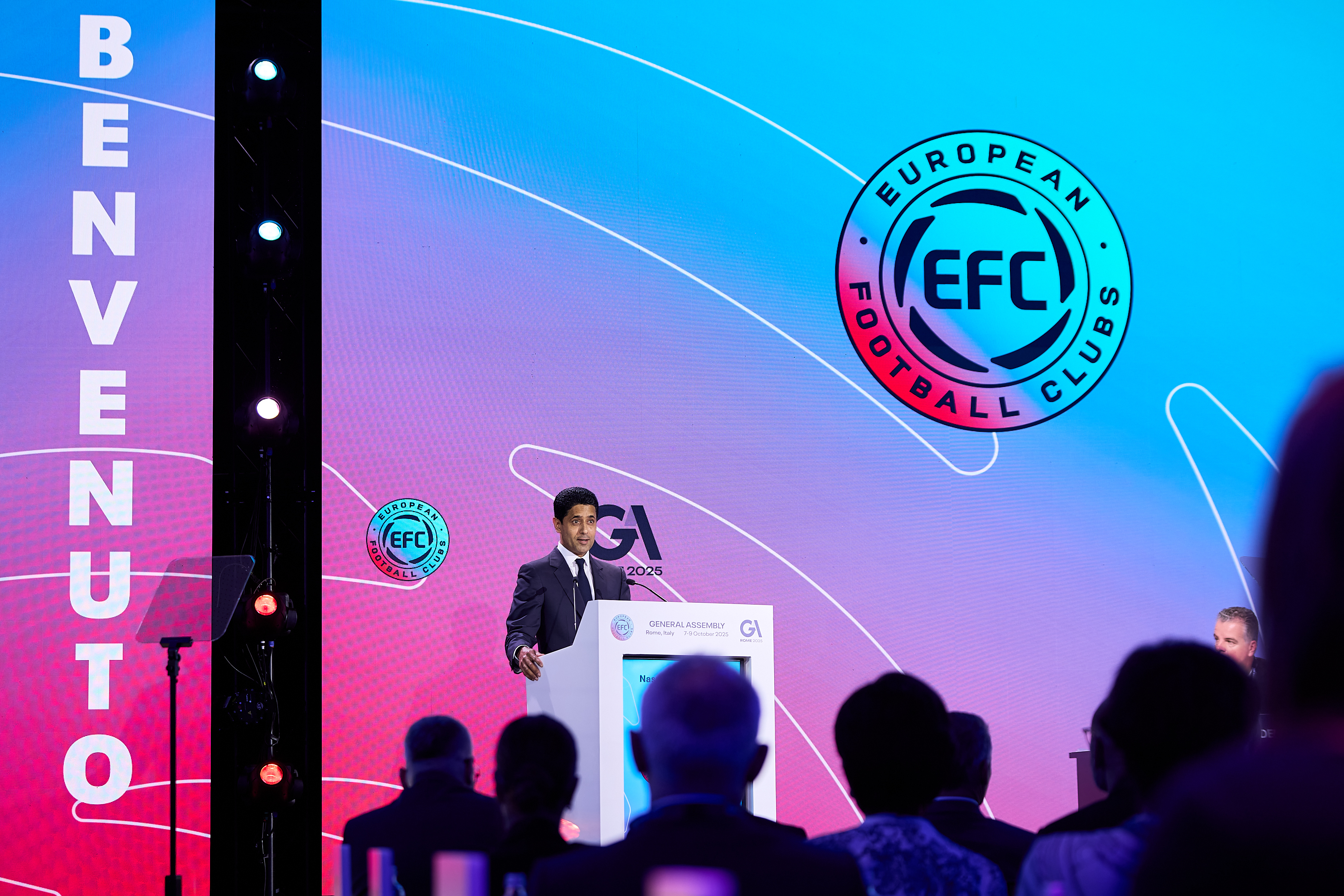
Nasser Al-Khelaifi wants to take one of European football's most influential organisations worldwide.
Speaking at the European Football Clubs General Assembly in Copenhagen on Tuesday, the EFC chairman announced plans to establish “World Football Clubs”, bringing clubs from around the world together under one representative organisation. He wants it established “as soon as possible”.
Quite what everyone would be signing up to hasn't been explained yet. There is no published membership structure, voting system or set of powers, and World Football Clubs isn't about to start organising World Cups or rewriting the Laws of the Game. Football has enough governing bodies to keep track of already.
It is easier to understand the idea by looking at what Al-Khelaifi has built in Europe.
European Football Clubs, previously the European Club Association, had 247 members when he became chairman in 2021. More than 900 clubs are now involved. Barcelona returned as an ordinary member in February after leaving during the European Super League fallout, while Real Madrid is moving towards reintegration following an agreement in principle with UEFA and EFC.
Five years after some of Europe's biggest clubs tried to build their own competition, most of them are gradually finding their way back into the same room.
EFC has changed quite a bit while they were away. UEFA recognises it as the representative body for European clubs, with the agreement between the two running until 2033. UEFA and EFC are equally represented on the board of UC3, the company responsible for managing, selling and delivering the commercial rights to UEFA's major men's and women's club competitions.
Al-Khelaifi put a fairly substantial figure on that relationship in Copenhagen.
“We expect our partnership with UEFA to generate more than €20 billion.”
For clubs, that relationship goes well beyond having somebody present when decisions are announced. EFC has built a recognised place for them within European football and, through UC3, a direct role in the commercial side of the competitions they play in.
Al-Khelaifi now wants to take that idea beyond Europe.
FIFA is built around 211 national member associations and already works extensively with professional clubs and leagues. Al-Khelaifi himself has represented EFC on the FIFA Council since October 2025, so clubs aren't exactly standing outside FIFA headquarters knocking on the window.
A worldwide organisation would give them another way to organise. If clubs across South America, Africa, Asia, North America and Oceania joined their European counterparts, FIFA could find itself dealing with a collective club voice when arguments emerge over the international calendar, player release, competitions, commercial rights and how money is distributed.
There is no shortage of material for the first meeting.
EFC's relationship with FIFA has already become strained. In July, the organisation complained that it learned through media reports about FIFA Forward Enterprise, a proposed commercial subsidiary that could have opened major FIFA commercial rights to private investment. EFC represented more than 850 clubs at the time and wasn't particularly impressed to discover a plan of that scale at roughly the same time as everyone else.
The proposal was eventually abandoned. The argument wasn't.
UEFA president Aleksander Čeferin arrived at the Copenhagen assembly with plenty still to say about it. Standing in the home city of Hans Christian Andersen, he found an appropriate reference.
“The emperor is naked.”
Čeferin compared FIFA's handling of the proposal to The Emperor's New Clothes and criticised the process behind it. FIFA disputes UEFA's account and has accused European football's governing body of conducting a “misinformation campaign”.
Football governance doesn't often give you private capital, €20 billion and a nineteenth-century Danish fairy tale in the same afternoon, so Copenhagen did well on that front.
The humour around it shouldn't disguise a genuine disagreement. FIFA, UEFA, national associations, leagues and clubs can find themselves pulling in different directions when calendars become busier or commercial decisions affect their competitions. The expanded Club World Cup has provided another example, with discussions continuing over the distribution of its $250 million solidarity fund.
World Football Clubs would give clubs another organisation through which to fight their corner, provided Al-Khelaifi can persuade enough of them that they share one.
That might prove more difficult than creating the name.
Real Madrid, Boca Juniors and Al Ahly operate in very different football and financial environments. The concerns of a Champions League regular aren't necessarily those of a smaller professional club in Africa or Asia. Even European football has spent the past few years providing a fairly convincing demonstration of what happens when powerful clubs decide their interests no longer match everyone else's.
EFC survived that rupture and came out considerably larger. Its membership has grown beyond 900, its relationship with UEFA runs until 2033 and clubs now have a direct role in the commercial operation surrounding European competitions.
That is the model Al-Khelaifi is taking to the rest of the world.
The name is ready. Now he needs the clubs.
If this one landed, the newsletter’s where the rest of it lives — two or three pieces a week, no noise.
Subscribe