 Touchline Sport
There are probably analysts around the League of Ireland who’ve spent three days preparing for Shamrock Rovers, only for the manager to walk in on Thursday afternoon and ask whether a back five might be a better idea.
Stephen Bradley has seen it often enough to stop being surprised. After Waterford changed to a back five at Tallaght in May, he explained that teams which normally play with four defenders regularly become a five against Rovers, while others go the opposite way. His answer isn’t to spend the week preparing for one specific shape. Rovers still analyse the opponent, but the bigger focus is on their own structure and the problems they already know how to solve. Bradley spoke about players recognising those changes in the first five, ten or fifteen minutes and drawing on “months and years” of previous work.
Since Bradley took charge in 2016, Rovers have won five league titles, including four in a row between 2020 and 2023 before reclaiming the championship in 2025. Players have changed, different versions of the back three have appeared and opponents have found increasingly creative ways of trying to stop them. The ideas underneath it have been much harder to shift.
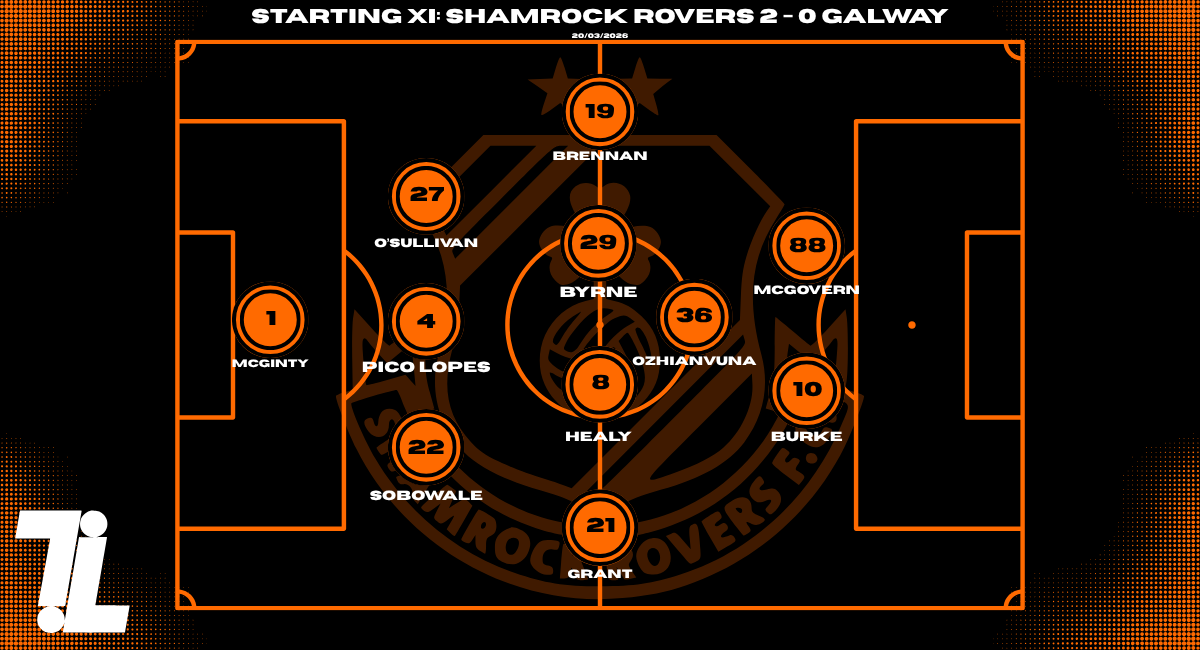
Rovers want the ball. Everybody knows that. What Bradley’s really coaching is what happens after the opposition starts moving because of it.
The 3-5-2 Is Only Where Rovers Start
Watch Rovers often enough and the formation graphic starts to feel more like admin than analysis. The 3-5-2 still matters. It gives Bradley three centre-backs, natural width through the wing-backs and enough central players to stagger the midfield. But once Rovers settle into possession, the more useful question is who’s occupying which line and who the opposition has decided to leave.
Writing 3-2-5 over every freeze-frame would be tempting, mainly because football tactics has already suffered enough from people discovering coloured magnets. Rovers are more fluid than that. The heights change and the spare player changes, but the relationships stay recognisable: width outside, support beneath the ball, somebody beyond the first line and enough security behind it to stop every defender stepping forward together.
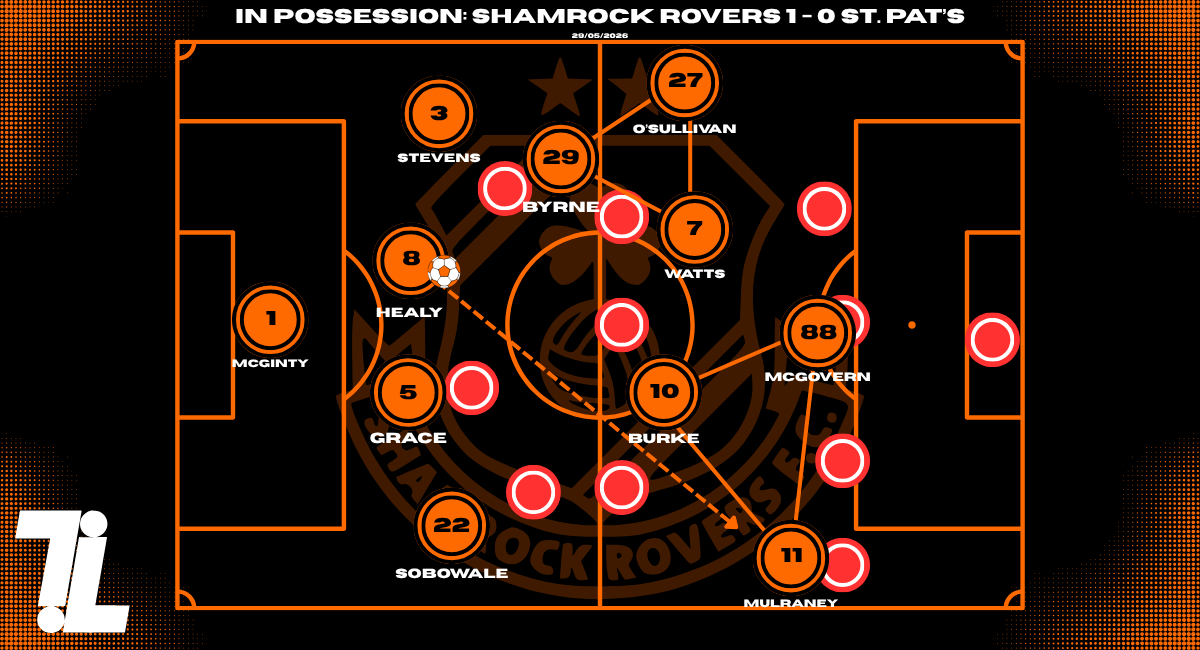
The opening league win over St Patrick’s Athletic gave a good look at it. Dan Cleary, on the right of the back three, stepped beyond what you’d normally think of as a centre-back’s zone and carried high enough to deliver from the right. Matt Healy showed his longer passing range underneath the attack, while Adam Brennan pushed high on the opposite side and spent large parts of the game looking far more like a winger than a fifth defender. Later, Healy was involved in the move for Michael Noonan’s opener and Brennan arrived at the back post for the second.
The same relationships were already there in Bradley’s 2023 title-winning side, even when Rovers switched between a 3-4-2-1 and a 3-5-2. The wing-backs stretched the pitch, wide centre-backs stepped into the half-spaces, midfielders dropped underneath possession and overloads on one side opened the switch to the other. Rovers averaged 57.34% possession and 83.47 progressive passes per 90 that season. Three years later, different players are still trying to create the same decisions.
Against two forwards, the back three should give Rovers a spare centre-back. If nobody engages him, he carries. If a midfielder leaves the second line to stop him, somebody behind him can become free. If the wide player jumps instead, the player inside or outside becomes the next option.
Rovers aren’t just looking for the free man. They’re trying to make the opposition create him.
The Build-Up Is About Making Somebody Leave Their Line
Bradley once described Rovers’ style as wearing teams down “mentally and physically” until gaps appear. That probably explains their circulation better than simply calling them a possession side. They don’t need to force the first forward pass available because much of the possession is there to make the defensive block change shape first.
That was already visible in 2023. The back three dropped close enough to the goalkeeper to encourage pressure, one midfielder could stay underneath the ball while players overloaded one flank, and the opposite wing-back waited outside the block. Once the opponent shifted, the pitch opened somewhere else. Rovers still averaged 56.17 long passes per 90, so Bradley’s possession football has never meant ten-yard passes until everybody gets bored.
The current team follows the same logic. Healy completes 84.8 passes per 90 at 90.0%, the highest volume in the squad. Byrne completes 69.7 at 86.1%, Lee Grace 65.9, Enda Stevens 60.8 and Roberto Lopes 59.0. They have enough security across those first two lines to keep moving the ball until the opponent gives them something worth attacking.
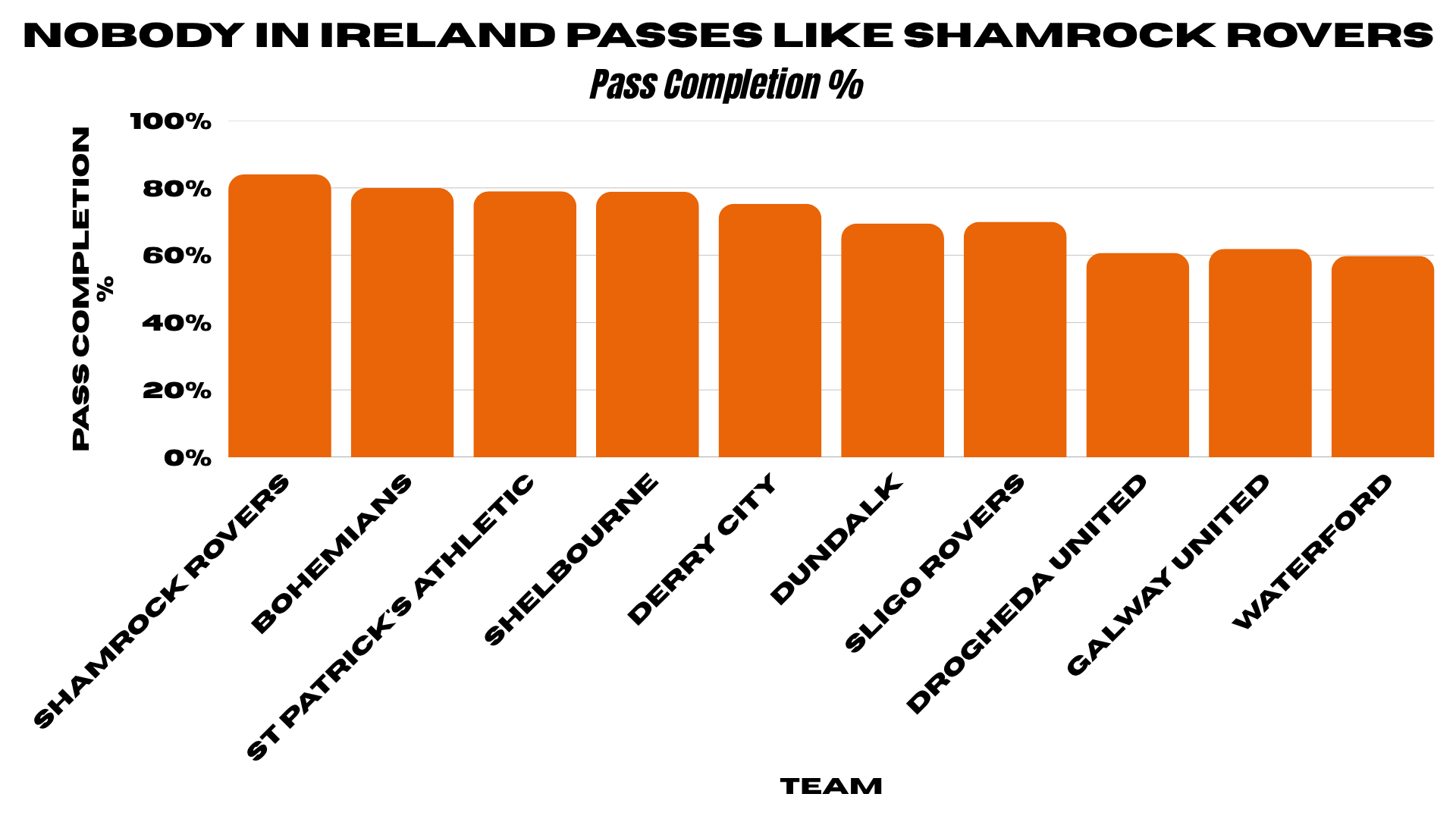
They’re not wedded to going short either. Lopes completes 5.6 long balls per 90, Byrne 4.9 and Healy 4.8. Healy’s long passing is completed at 58.6%, Byrne’s at 53.6%. If the opposition has spent ten seconds being dragged towards one side, the switch isn’t Rovers abandoning the plan. Quite often, it’s the plan paying off.
The spare centre-back carries. A midfielder has to decide whether he’s leaving Healy or Byrne to stop him. If he does, Rovers play through the player he’s just left. If the block slides across, the far wing-back becomes the next target. If nobody comes out, the centre-back keeps walking.
You can almost see the moment the defender starts wondering whether this is actually his problem.
One 2023 sequence summed it up nicely. Cleary carried from right centre-back, found Neil Farrugia and kept running beyond him. By the time he received the return pass, four opposition players had been drawn towards that side. The run hadn’t just added another body to the attack. It had changed where four defenders were looking.
KuPS gave the current side one of their better tactical tests because they attacked that process differently. They were more interested in the next reception than the current ball-carrier. Miika Nuutinen’s side tried to force Rovers onto weaker feet, Valentin Gasc stayed close enough to Graham Burke to stop him receiving cleanly between the lines, and Byrne found traffic when he came deeper.
A centre-back can look free, but if the next player can’t receive facing forward, the spare man hasn’t solved much. KuPS were worried about the players who could turn possession into progression, not whether everybody got a touch.
Healy Gives Them Stability. Byrne Looks For The Next Gap.
The midfield works because Bradley doesn’t ask everybody to do the same job. Healy is usually underneath the attack, giving the centre-backs a safe option, changing the point of attack and giving Rovers somewhere to come back to if the first route closes. Byrne has far more freedom to find the spaces that appear once opponents follow those earlier movements.
Byrne has completed 1,489 league passes at 86.2%, but his creative output is the bigger part of his role: 62 chances created, 10 big chances created and 5.98 xA. Nobody else in the squad is close to his overall chance-creation volume.
Their relationship is often best when they’re not standing on the same line. If Byrne drops towards a centre-back and drags a midfielder with him, Healy can become the third player in the next action: centre-back into Byrne, Byrne back into Healy, Healy forward past the player who’s just been pulled out. The first pass hasn’t beaten anybody. It’s moved the defender so the next one can.
That’s third-man football without turning the paragraph into a coaching badge.
The same principle appears out wide. Brennan is a good example of Bradley recruiting for what the role has to do rather than what the position used to be called. He arrived from UCD having played mostly as a winger. In 2026 he has started 16 league matches, played 1,499 minutes, scored three, assisted four, produced 3.44 xA, created 25 chances and seven big chances, and taken 90 touches inside the opposition box.
The Galway game in June showed why that profile works. Brennan changed a flat first half by carrying down the left and clipping the cross for Aaron Greene, then beat Jimmy Keohane before setting up John McGovern. Both goals came from the nominal left wing-back doing the things Rovers signed a winger to do.
If Brennan stays wide, the opposition’s wide defender can’t simply collapse inside around Byrne. Jump early and the channel opens. Stay narrow and Brennan gets the one-v-one. Somebody has to keep the width or the whole thing becomes much easier to squeeze.
The winger doesn’t own the touchline. The team does.
Rovers Control Games Better Than They Create Chances
There’s one part of the season that stops this becoming a piece about how clever Rovers are. Their control of the ball is comfortably the best in the division. Their chance creation isn’t.
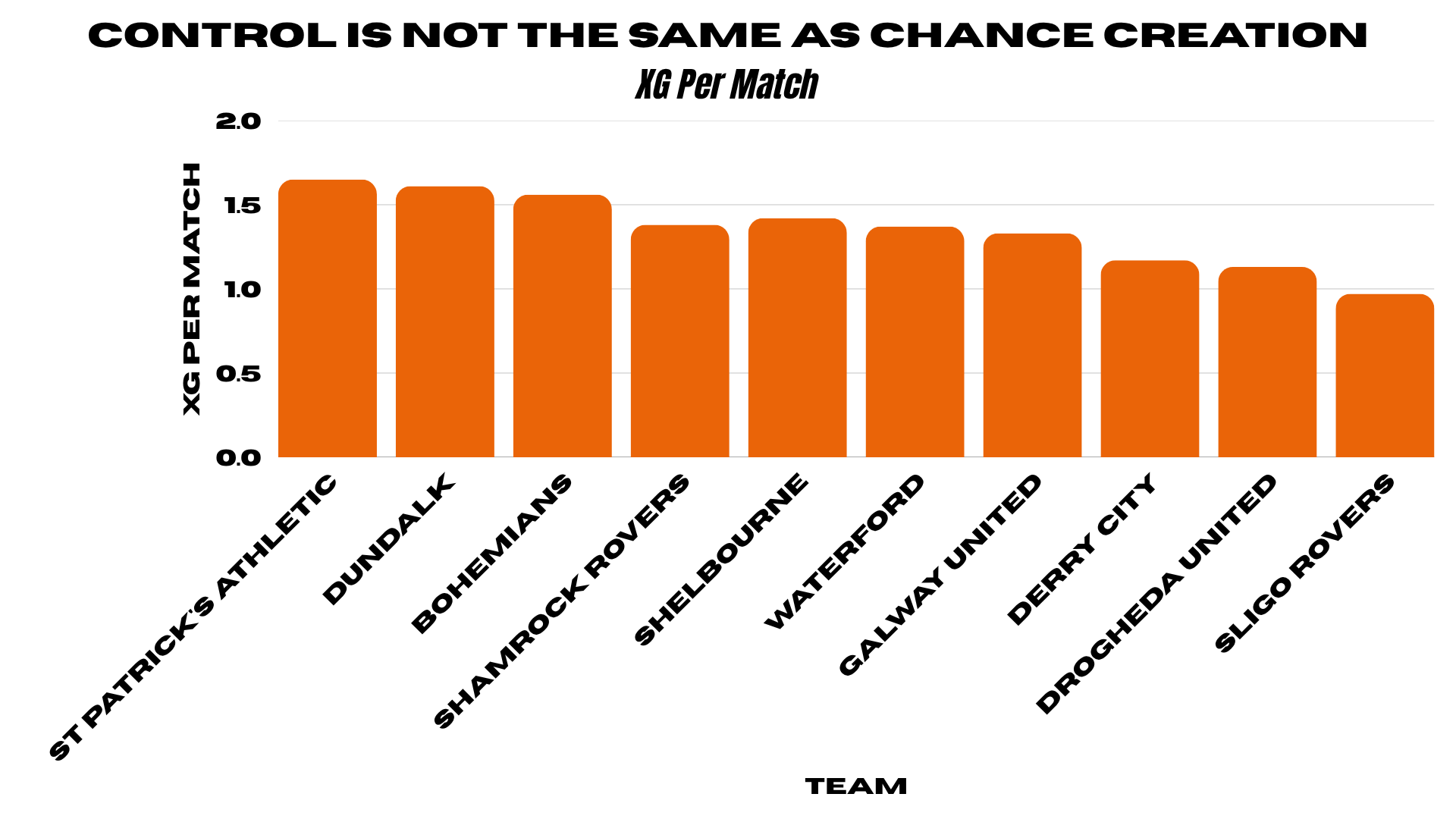
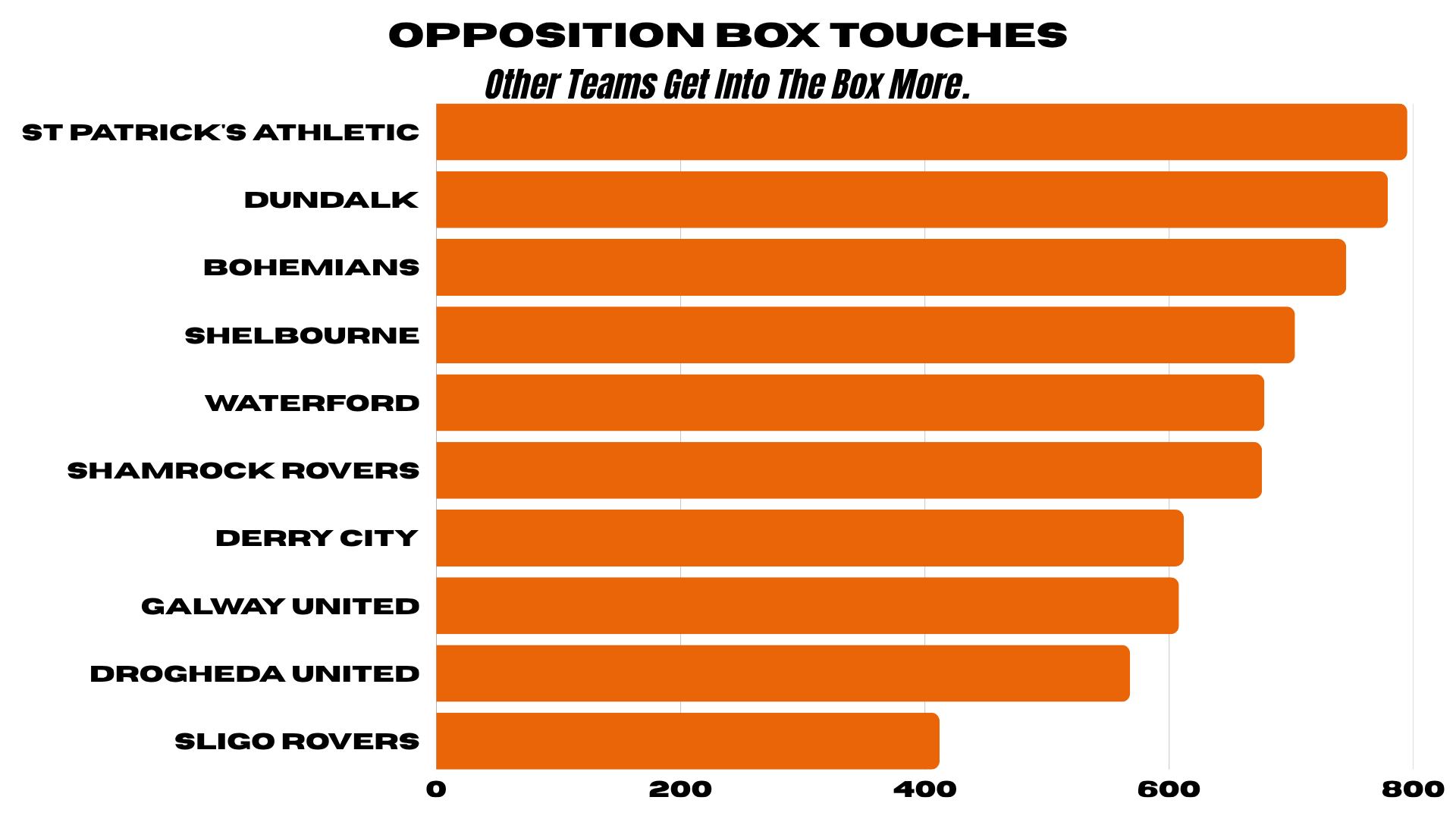
The latest expected-goals table has Rovers on 39.9 xG, fourth behind St Patrick’s Athletic on 47.9, Dundalk on 46.7 and Bohemians on 45.3. Their 4.9 shots on target per match also ranks fourth, while 676 opposition-box touches leave them behind St Pat’s, Dundalk and Bohs despite spending far more time with the ball.
That’s probably the most interesting tension in Bradley’s current model. Rovers are brilliant at deciding where the game is played, but that doesn’t always mean they’ve properly opened the team sitting in front of them.
Shelbourne have shown both sides of it. In June they defended deeper, protected their own half and waited for Rovers to leave something behind. Their winner came from exactly that situation: Sam Bone found JJ Lunney deep, Lunney moved it to Harry Wood and Wood released Mipo Odubeko before Rovers had recovered behind the ball.
The September meeting was different. Shelbourne competed higher up and reduced Rovers’ possession, but Bradley’s side still forced them backwards for spells. The game finished 0-0 and Ed McGinty had to make the biggest save of the night. There isn’t one magic formation that switches Rovers off. The better sides are choosing which Rovers players they’re happy to leave on the ball.
If an opponent is happy for Grace or Lopes to have possession and stays compact around Byrne, Burke and the wing-backs, the usual manipulation doesn’t happen automatically. The centre-back can carry, recycle and go again, but somebody still has to disturb the block.
You can’t drag a defender out if he’s decided he quite likes where he is.
Rovers have scored 46 goals from 39.9 xG, an overperformance of 6.1 goals. Their xG difference is +9.4, while their actual goal difference is +19, so the scoreboard is running 9.6 goals ahead of the underlying chance differential.
They’re top for a reason. Their biggest advantage isn’t that they batter everybody with chances. It’s that they control games for long enough and have enough quality to turn a smaller number of good moments into goals.
They Defend With The Ball More Than The Pressing Reputation Suggests
Bradley’s teams have had seriously aggressive pressing numbers before. In 2023 Rovers posted a PPDA of 8.94, made 637 counterpressing recoveries and recorded 421 high regains, with 180 leading to a shot within 20 seconds. The press was another way of creating the disorganised opponent Bradley wanted.
The 2026 team looks different. Rovers regain possession in the attacking third only 2.9 times per match, eighth in the division. Dundalk lead at 4.8, while Derry and Galway are both at 4.1. Yet Rovers have conceded only 27 goals, and their 29.7 xGA is the second-lowest total in the league, behind St Pat’s on 27.9.
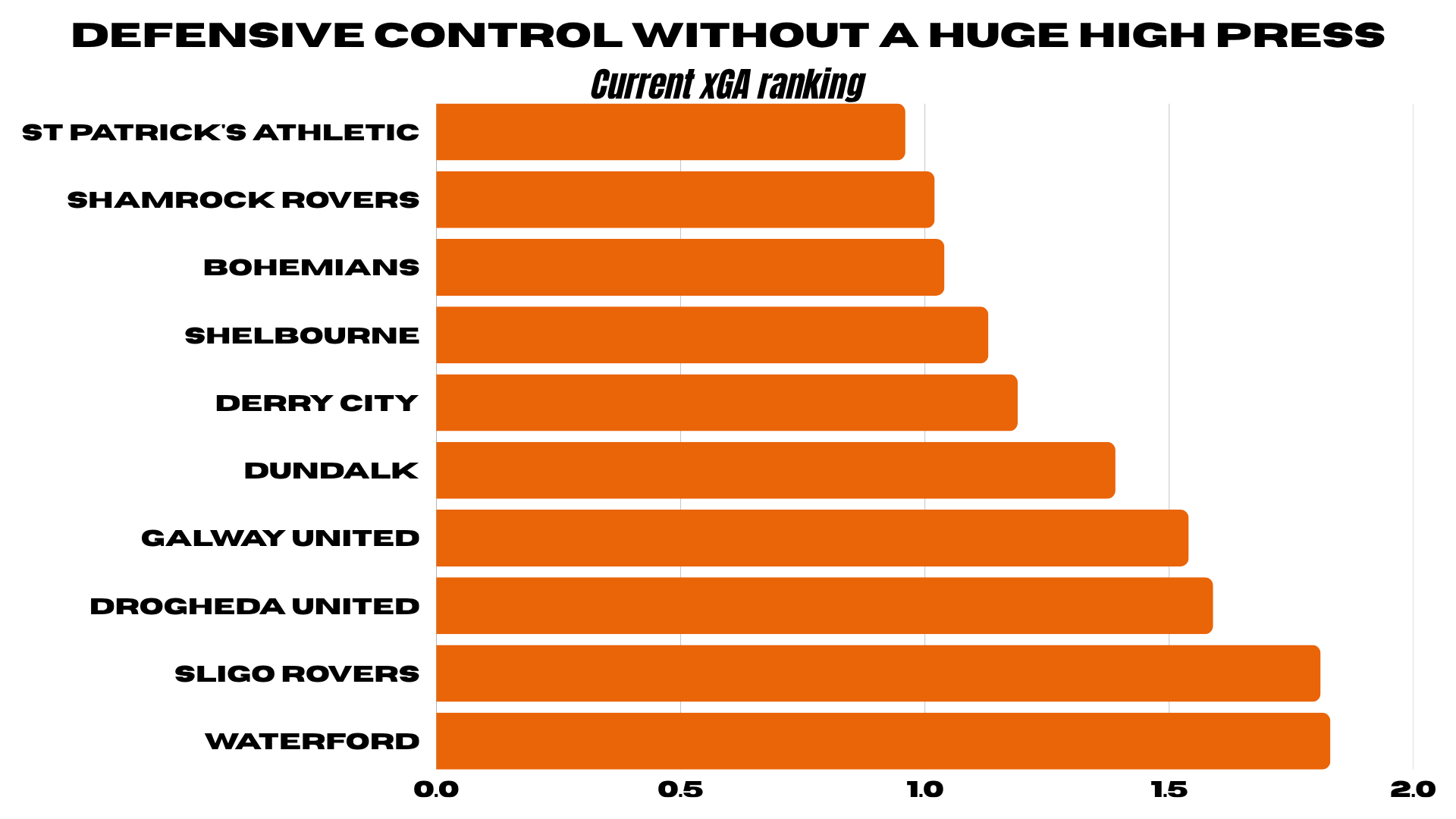
Bradley hasn’t stopped wanting control. This version just gets more of it through possession and territory than through repeatedly winning the ball beside the opposition penalty area. With Rovers spending so much of matches in possession, opponents simply get fewer attacks, while the back three gives another layer underneath the ball.
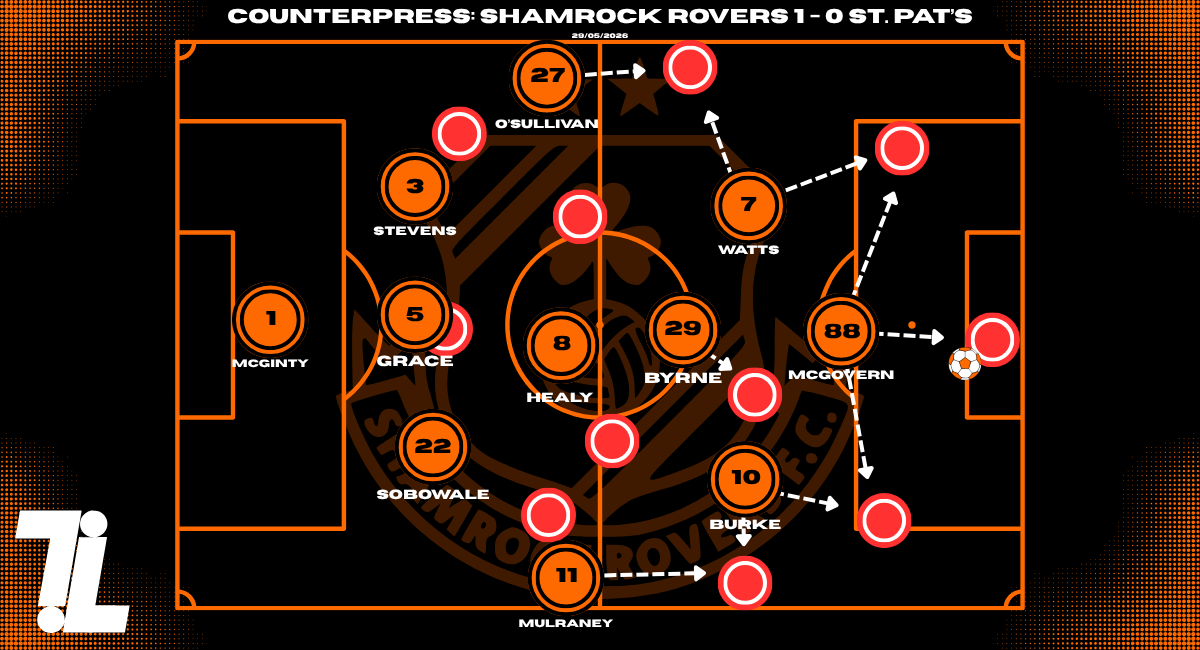
The problem comes when those distances stretch. Sligo’s 97th-minute winner at Tallaght in May is the cleanest example. Sobowale misplaced a pass, Ryan O’Kane collected it and immediately found Carl McHugh, who finished from the edge of the area. Sligo didn’t need six passes or some perfectly rehearsed counterattack. They made the first action after the regain a forward one before Rovers could reset.
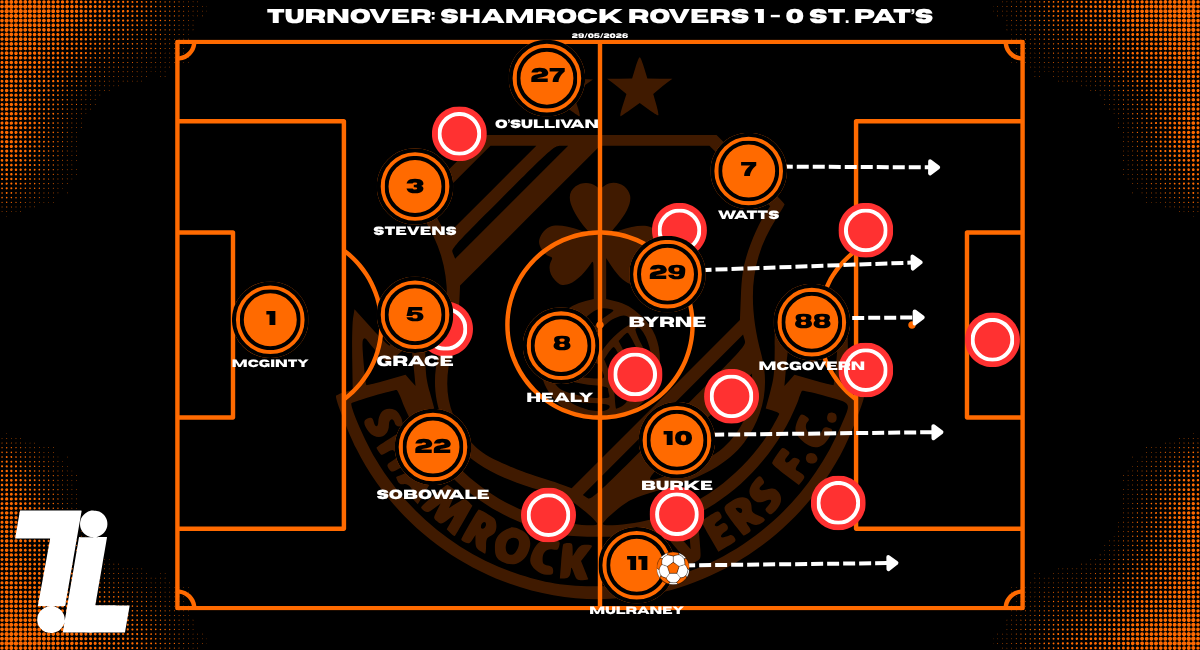
That first pass is huge against them. Once Rovers lose the ball, the closest player needs to win it back, block the forward lane or at least slow the receiver. If the opponent escapes that first pressure, the wide centre-back can suddenly be defending the channel the wing-back has just left.
Rest defence is a slightly grand way of asking whether you’ve left enough people in sensible positions if the attack collapses. Rovers normally have. The danger comes in the few seconds before those positions make sense again.
How Do You Make Rovers Uncomfortable?
The best opponent performances in 2026 haven’t all looked the same, but they’ve shared a few ideas.
First, don’t feel obliged to press the spare centre-back. Waterford’s switch to a back five gave them natural coverage across Rovers’ width, while Shelbourne have been happy to let possession stay with the less dangerous players. Bradley has seen teams change specifically for Rovers often enough that he now treats it as normal.
Second, press selectively. KuPS showed it well. Don’t send somebody charging at Lopes just because the ball is there. Close the player you don’t want receiving next, dictate his first touch and make the backwards pass easier than the forward one. Rovers want you to jump so they can use the space you leave. There’s no rule saying you have to be helpful.
Third, make the first forward pass after a regain count. Shelbourne did it. Sligo did it. The useful space can be the channel beside the outside centre-back after he’s stepped forward underneath the attack. Make him turn towards his own goal and the picture changes quickly.
Egnatia was the extreme warning. Rovers travelled to Albania protecting a 3-1 first-leg lead and found themselves 3-0 down inside 20 minutes, eventually losing 5-1 and 6-4 on aggregate. Individual mistakes were everywhere: poor passes, bad decisions around crosses and a breakdown in communication. Bradley called it the worst performance he’d seen from his team.
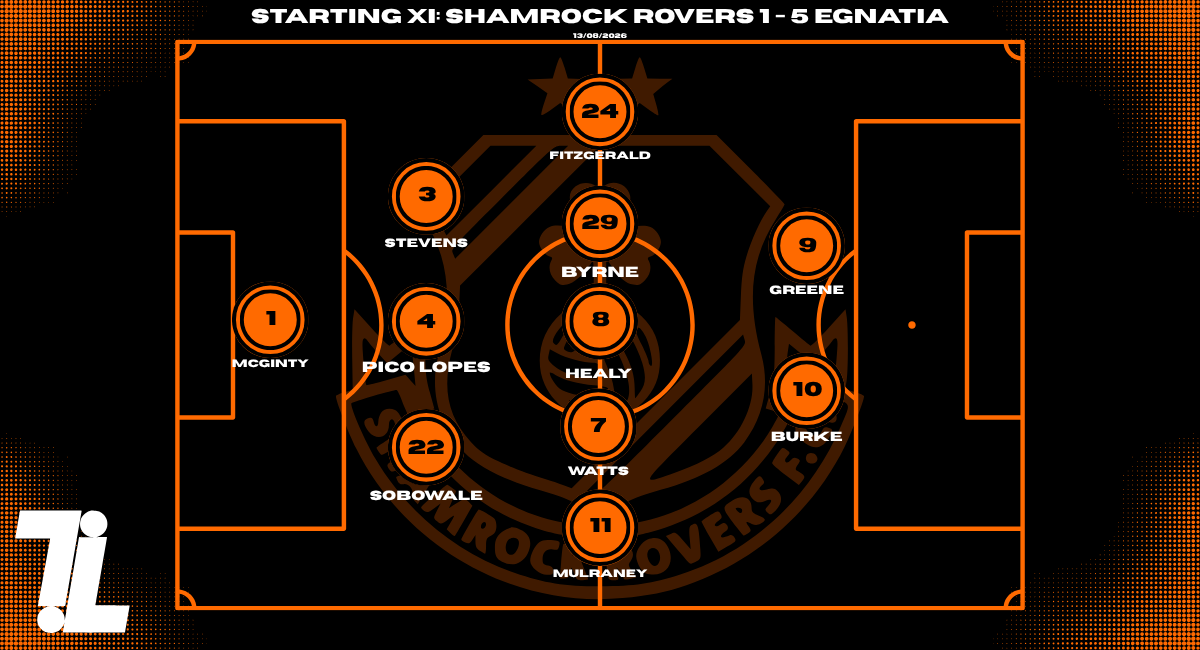
It’d be lazy to turn one awful European night into proof that the whole structure is flawed. What it showed was how little margin there can be when you position players aggressively around the ball. If the first action is right, those positions give you options. If it goes straight to the opposition, they suddenly look very open.
Football tactics can survive somebody passing to the wrong team. They struggle when it happens repeatedly in Albania.
Bradley Is Coaching Recognition, Not A Shape
Perhaps the best example of Rovers adapting without becoming a completely different team came at Derry in August. They were 3-1 down at half-time, but Bradley didn’t throw the game model away and start chasing the match with hopeful balls. He changed the profiles occupying it. Will Fitzgerald came on after 69 minutes and supplied Burke three minutes later. Dylan Watts arrived late and equalised almost immediately. Rovers found a different route into the attacking line without abandoning the ideas around width, support and occupation.
That comes back to Bradley’s comments after the Waterford game. He isn’t trying to coach one answer to one formation. He wants enough repeated pictures stored in the players’ heads that when an opponent changes something, they can recognise what’s disappeared and what must have opened somewhere else.
The 2023 side shows how long some of those pictures have been there. Wing-backs stretched the pitch, midfielders supported underneath the ball, wide centre-backs carried into the attack and overloads opened the opposite side. The formation changed then too. The relationships didn’t.
The current numbers give the model a slightly different look. Rovers lead the league’s passing numbers by a huge margin and have the second-best xGA, yet they’re fourth for attacking xG and eighth for final-third regains. They’re not dominating because every attacking metric is miles ahead of everybody else. They’re doing it by controlling possession, territory and the decisions opponents keep having to make.
So next time Rovers play, ignore the formation graphic once the ball gets moving. Watch the first opponent who leaves his line to press. Watch where Healy sits underneath the ball. Watch whether Byrne comes towards it or waits beyond the midfielder. Watch Brennan when the play is on the other side. Watch Burke when a centre-back has to decide whether to follow him.
Then watch what Rovers do when the opponent changes the picture.
The 3-5-2 tells you where Shamrock Rovers start.
Bradley has spent nearly a decade coaching what they do after somebody moves.
If this one landed, the newsletter’s where the rest of it lives — two or three pieces a week, no noise.
Subscribe for free