 Touchline Sport
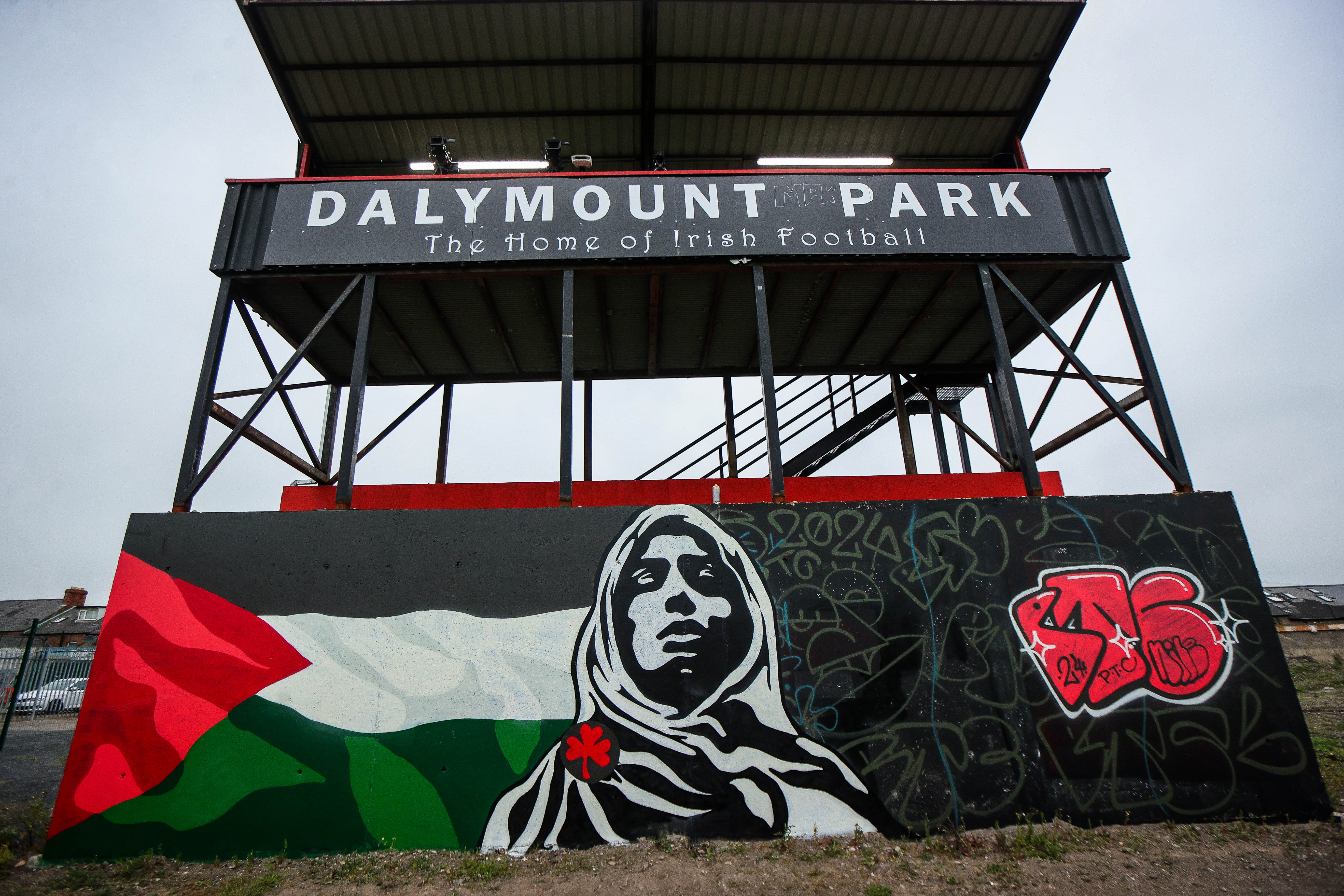
For Ireland, these were never going to feel like ordinary Nations League fixtures.
When Ireland formally recognised the State of Palestine in May 2024, Taoiseach Simon Harris reached back more than a century to 1919, when Ireland itself asked the world to recognise its right to exist as an independent state. His point was simple enough: Irish history gives questions of recognition, occupation and self-determination a particular resonance here.
Ireland continues to recognise Israel and support a two-state solution, but support for Palestinian statehood has been part of Irish foreign policy for decades rather than something that appeared after October 2023.
Now the national team has been dropped into the middle of that history.
Heimir Hallgrímsson’s side begin their Nations League campaign away to Kosovo in Pristina on Thursday, 24 September. Three days later comes the first Israel game, officially an away fixture for Ireland but being played at the Nagyerdei Stadion in Debrecen, Hungary.
Ireland then return to the Aviva Stadium to face Austria on Thursday, 1 October before meeting Israel again on Sunday, 4 October. That second game is officially Ireland’s home fixture, but it has been moved out of Dublin and will instead be played behind closed doors at the TSC Arena in Bačka Topola, Serbia.
Four matches in 11 days, with the two Israel fixtures taking place in two different neutral countries and neither resembling anything close to a normal home-and-away international.
The usual Ireland media day has been cancelled. For the nominal home fixture, sponsors will disappear from FAI backdrops, regular perimeter advertising will be replaced by UEFA Respect messaging and the association has asked not to host Israeli FA officials at the traditional pre-match gathering.
RTÉ will show both games because its contract requires it to, but there’ll be no studio presentation, no punditry and no RTÉ commentator. Commentary will instead come from UEFA’s international feed, only a minimal technical team will be used and there’ll be no advertising or sponsorship around either broadcast.
There isn’t much left once all of that is removed beyond the football UEFA requires Ireland to play.
Hallgrímsson has been open about how uncomfortable he is with the situation. He previously said he believes Israel should be suspended in the same way as Russia, and returned to the comparison this weekend.
“I haven’t had any explanation why one is banned, and the other one is not.”
He then went further.
“We’re not playing with genocide, we’re playing against genocide.”
For a manager preparing Ireland for four international matches, football barely got a look in. Hallgrímsson admitted afterwards that he may have said too much and described the situation as unlike anything he has dealt with before. His line that there is no UEFA Pro Licence seminar for this probably said more about the week ahead than anything on formations or team selection.
The comparison with Russia is more complicated than simply asking why one country is banned and another isn’t. FIFA and UEFA suspended Russian clubs and national teams in February 2022 following the invasion of Ukraine, amid widespread refusals by European federations to play Russia, safety concerns and growing problems around actually staging the fixtures.
There is no automatic UEFA rule which says a federation must be suspended because its state is involved in armed conflict.
The FAI has still gone further than any other UEFA association in challenging Israel’s continued participation. Its members voted in November 2025 to formally ask UEFA to suspend the Israel Football Association over alleged breaches of UEFA statutes. When Ireland were then drawn alongside Israel in the Nations League, the association confirmed the games would be played because refusing them could bring forfeits and further disciplinary action.
That position has been debated inside Irish football too. In July, FAI delegates voted 75-32 to fulfil the fixtures, with three abstentions. The association’s concern was that walking away on its own could cost Ireland six points and create further problems around rankings, Nations League status and future competition.
So the matches remain, even if almost everything normally attached to them is disappearing.
RTÉ has followed a similar path. SIPTU had called on the broadcaster not to show the games and said it would support staff who refused to work on them. RTÉ maintained it could not simply abandon its contractual obligations. The result is a broadcast that fulfils those obligations while looking nothing like the coverage Irish supporters are used to seeing around their national team.
In Ireland, that carries a little more emotion than it might elsewhere. Palestinian flags have long been visible at Irish sporting and political events, while successive governments have spoken openly about Palestinian statehood and self-determination. When Ireland recognised Palestine in 2024, Micheál Martin described it as the fulfilment of a long-standing commitment rather than a sudden change in direction.
Football doesn’t stop being football because politics has arrived around it. But it doesn’t happen in isolation either.
On 27 September there’ll be no Irish crowd in Debrecen. On 4 October there’ll be no Irish home crowd at all. No familiar RTÉ panel. No sponsor branding. No traditional pre-match gathering.
The green shirts will still be there. The anthem will still play. Ireland will still have points to win.
It just won’t feel much like a normal Ireland international.
Before any of that, Hallgrímsson has Kosovo to worry about in Pristina.
Then come the two Israel games, stripped of so much of what normally makes an Ireland international feel familiar. No Irish crowd in Debrecen. No real home game in Dublin. No usual RTÉ build-up. No sponsor boards. No comfortable sense that this is just another fixture on the calendar.
The green shirts will still be there. The anthem will still play. Ireland will still have points to win.
But for a country where questions of recognition, occupation and self-determination have never felt especially abstract, these matches were always going to carry something heavier with them.
And when the ball finally rolls, that weight won’t disappear just because the referee blows the whistle.
If this one landed, the newsletter’s where the rest of it lives — two or three pieces a week, no noise.
Subscribe